


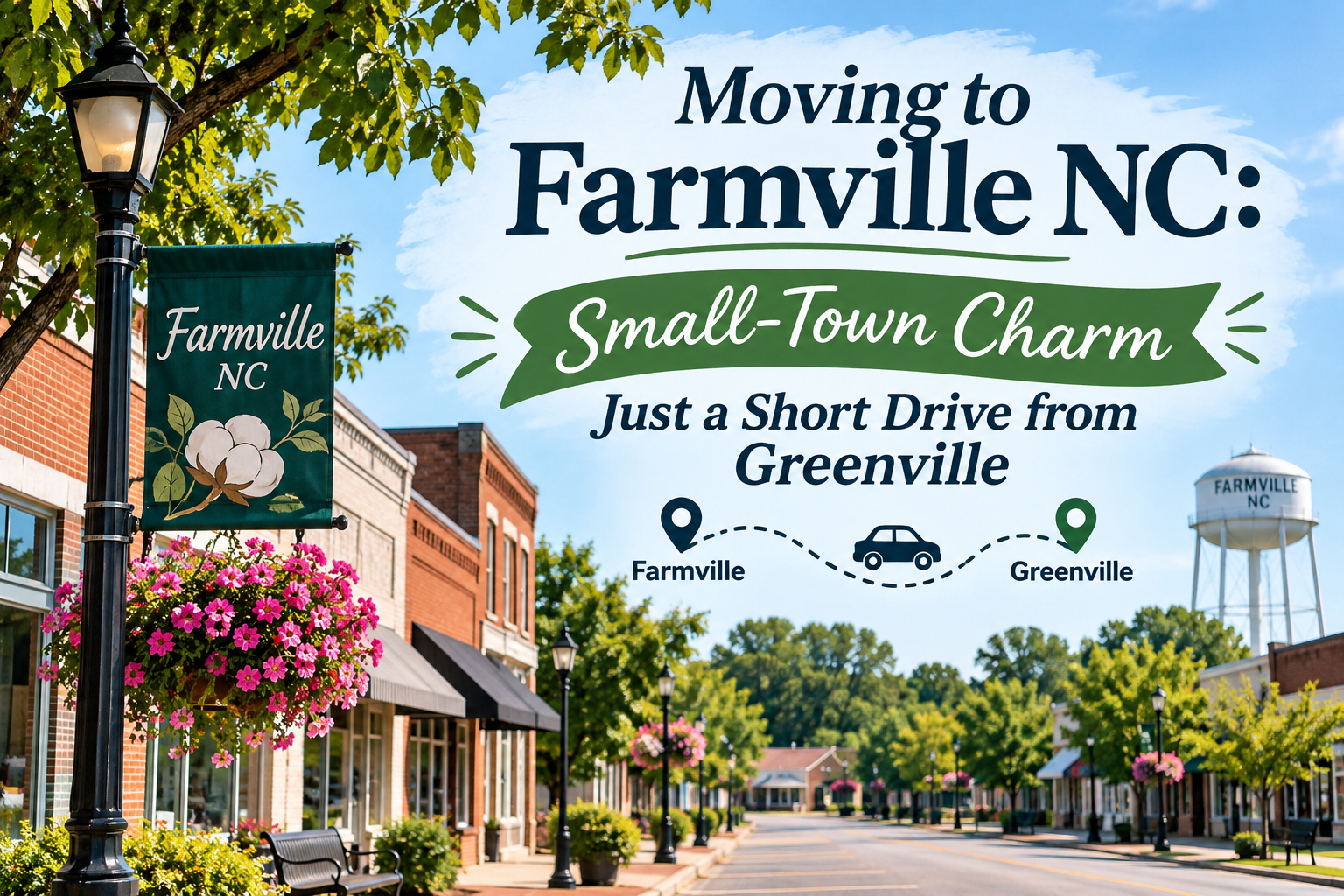
By Denise Davis, REALTOR® | Fresh Start Realty | Serving Greenville & Pitt County, North Carolina
If you've been weighing the idea of trading city living for something quieter, more affordable, and genuinely welcoming, Farmville NC deserves a serious look. This Pitt County town sits just a short drive from Greenville, and it delivers on nearly every front that matters to relocating families, commuters, and remote workers alike.
Thinking About Moving to Farmville, North Carolina?
Farmville is known for its historic charm and close-knit community feel, and that reputation isn't marketing fluff. With approximately 4,800 residents and a population well under 5,000, this is authentic small town living in western Pitt County, about 15 to 20 minutes from Greenville and everything that comes with it: East Carolina University, ECU Health Medical Center, and the broader job market of a regional hub.
Who thrives here? Commuters to Greenville who want quieter evenings and bigger yards. First-time buyers stretching their dollar further than Greenville allows. Pre-retirees seeking walkability, community, and lower costs. Remote workers who need reliable internet but prefer birdsong over traffic noise. Farmville offers all of that without feeling isolated.
At Pitt County Living (Powered by Fresh Start Realty), we specialize in Farmville and the surrounding small towns of eastern North Carolina. If you want to explore what's available right now, browse our Farmville home values and market report or reach out for a custom market snapshot tailored to your budget and wish list.
Farmville NC at a Glance
Farmville sits roughly 8 miles west of Greenville in western Pitt County. It functions as a local hub for surrounding rural areas while remaining an easy drive from larger amenities. Raleigh is about 1.5 hours by car, the Crystal Coast beaches are 1 to 1.5 hours east, and access to I-95 falls within a 30 to 40 minute drive.
Key numbers paint a clear picture of what to expect. Median household income is around $47,000, reflecting a rural economic base. Median home value sits at approximately $183,000, notably lower than state and national averages. The overall cost of living in Farmville is roughly 6 percent lower than the national average, making it more affordable than larger cities across North Carolina.
Climate-wise, Farmville experiences four distinct seasons with high humidity during summer months. Expect hot summers with temperatures regularly in the 90s, mild winters that occasionally touch freezing, about 52 inches of annual rainfall, and just a few inches of snow. Heavy seasonal pollen and occasional flooding are issues worth noting, but you won't deal with harsh northern winters or persistent ice.
Small Town Charm, Big Sense of Community
Farmville was called the friendliest little town in the state back in the 1920s, and that nickname still rings true. This is the kind of place where neighbors wave from porches, local businesses greet regulars by name, and kids ride bikes to the park after school. Farmville's tight-knit community encourages neighborly interactions and involvement in local activities in a way that larger towns simply can't replicate.
Community spirit here is characterized by annual events and local parades that bring the whole town together. The Dogwood Festival each spring is the signature gathering, drawing visitors from across the Farmville area and beyond. Farmville also hosts a Christmas parade and Hometown Halloween annually,
plus seasonal concerts on the town common and shows at the Paramount Theatre. The Farmville Chamber of Commerce and local civic groups keep the calendar full year-round.
That spirit runs deep. Residents built a $165,000 fountain as a gift to the town, a tangible sign of how much people invest in this community. Farmville was even named a finalist in the All America City competition, recognition that validates what locals already know: this small town punches above its weight when it comes to civic pride.
Churches, clubs, and arts organizations create quick on-ramps for newcomers who want to get involved. You won't feel like an outsider for long.
Rich History and the Walkable Historic District
Farmville's rich history stretches back to mid-1700s settlement, and the town was formally incorporated in 1872 during a period when the tobacco industry and tobacco sales shaped eastern North Carolina's economy. Major Benjamin May was among the early influential figures, and the town grew steadily as a tobacco-market center through the early 1900s.
The crown jewel is the historic district, which was added to the National Register of Historic Places in 1993 with more than 330 contributing historic buildings dating from roughly 1860 to 1942. Walking through historic Farmville feels like stepping into a different era:
-
The Paramount Theatre, built in the 1930s, anchors downtown Farmville with Art Deco flair and hosts live performances through Farmville's Community Arts Council.
-
The James W. May House dates back to around 1860, now preserved as the May Museum and Park, Pitt County's only full-time history museum.
-
The historic Bank of Farmville building, designed in 1921, and church steeples define the skyline.
-
Main Street features businesses over 50 years old alongside newer galleries, artisan coffee shops, and small shops that give historic façades a second life.
The town of Farmville features historical architecture and independent local shops instead of generic chains. Farmville has a compact, walkable downtown featuring local artisan shops and galleries, and beyond the district you'll find newer construction on quieter streets.
The contrast between old and new is part of what makes Farmville feel like a new town to discover, even for visitors who think they know eastern North Carolina.
Housing and Real Estate in Farmville NC
Understanding the broader market helps frame what Farmville specifically offers. The median list price for homes in Pitt County is around $289,900, with roughly 600 to 700 active listings countywide and homes staying on market about 60 days on average. For deeper context on county trends, check out our guide to understanding the Pitt County real estate market.
Farmville itself is a different story. Housing prices in Farmville are lower than in surrounding urban areas, and homes in Farmville often provide more space for lower prices than Greenville.
Many houses fall comfortably under $250,000, and the housing market features larger lot sizes than what you'd find in Greenville neighborhoods at the same price point. Farmville's property taxes are based on Pitt County's assessment rates, keeping ongoing costs manageable.
You'll find a diverse range of property types:
-
Historic homes near downtown with ornate woodwork, porches, and mature landscaping
-
Post-war brick ranches in established neighborhoods with big yards
-
Modern subdivisions with open-concept floor plans, energy-efficient designs, and contemporary finishes
Farmville has ongoing new construction opportunities, and many new homes come with warranties. Average lot sizes in new construction are generous yet manageable, and these developments cater to modern buyer demands without sacrificing the slower pace that drew you here in the first place.
Whether you're a first-time buyer trying to figure out what credit score you need or a move-up buyer curious about what determines your home's value, our team at Pitt County Living can provide instant valuations, custom reports, and on-the-ground insight into which Farmville streets fit your life.
Schools, Healthcare, and Everyday Amenities
Local schools in Farmville are part of the Pitt County Schools system. Farmville's schools serve grades K-12, with Farmville Central High, Farmville Middle, and local elementary schools offering athletics, vocational programs, fine arts, and community-supported extracurriculars. Graduation rates have improved in recent years, and the schools remain an anchor of town life even as families weigh options across the county.
Day-to-day life inside town limits doesn't require constant trips to Greenville. Here's what's covered locally:
-
Grocery and pharmacy options for routine shopping
-
Farmville Municipal Library, which is fully town-funded and well-used
-
Casual dining and restaurants along and near Main Street
-
Medical clinics, dental offices, pediatric care, and eye care for routine visits
-
Veterinary services for pet owners
Healthcare access is limited locally for advanced or specialized needs, often requiring travel to Greenville's ECU Health Medical Center, about 24 minutes away. For day-to-day wellness, though, Farmville covers the basics.
For families with children, Farmville has six parks for recreation, including playgrounds, a splash pad, athletic fields, and a disc golf course. Youth sports leagues run through Parks and Recreation in spring and fall, giving kids plenty of green spaces to burn energy.
Commute, Connectivity, and Regional Access
The average commute time for residents in Farmville is around 30.4 minutes, and most commuters head toward Greenville via US-264 or NC-11. Commuting to Greenville takes about 15 to 20 minutes depending on your starting point, with largely uncongested roads, scenic farmland, and far fewer stoplights than you'd expect from other areas around a university city.
Farmville's strategic location offers easy access to major highways, connecting to Raleigh in about an hour and a half and the coast in 1 to 1.5 hours.
Public transportation options are minimal, making a car essential for daily life in Farmville. That said, once you're in town, downtown Farmville is walkable enough to park once and walk to shops, restaurants, and the park.
Farmville's local economy is relatively small, leading many residents to commute for work, but the town isn't without employers. Farmville has over 2,100 industrial jobs, and Health Care and Social Assistance is the largest employment sector.
Alliance One employs 500 people in Farmville, contributing to economic development alongside existing businesses and local commerce. Farmville's Economic Development Council, established in 1956, continues to support growth, and the town has a small business incubator to support local entrepreneurs looking to create a new business right here.
The executive director and town government actively court investment while preserving the community character that makes Farmville an ideal choice for those seeking a slower pace.
Things to Do: Arts, Parks, and Small-Town Fun
Don't let the population fool you. There's not a lot of sprawl, but there's plenty to explore on any given weekend.
The Art Trail stretches 1.2 miles through downtown, connecting murals, sculptures, a glassblowing studio, and galleries. Farmville has a community arts council for local exhibitions, and the Paramount Theatre hosts live performances, musicals, and community theatre throughout the year. For a town this size, the arts scene has a surprisingly sophisticated edge.
Outdoor activities are plentiful across several parks. The Farmville Country Club features a Donald Ross-designed golf course, and Oliver Murphy Nature Park offers walking trails through wooded terrain. The town common, splash pad, and disc golf course round out options for families and visitors alike.
Downtown experiences create a weekend without ever leaving Farmville: grab coffee from a local roaster, eat eastern North Carolina barbecue, taste craft beer at Yard Dog Brewery, and stroll among boutiques and antique shops. Beyond the Dogwood Festival, annual events like holiday parades, seasonal markets, and concerts on the town common reinforce small town charm and give newcomers fast ways to plug into the community. Town hall and the Farmville Chamber can point you toward what's coming up next.
Is Moving to Farmville NC Right for You?
Farmville fits certain lifestyles exceptionally well:
-
Commuters to Greenville who want excellent schools, quiet nights, and a front porch instead of a parking deck
-
Families seeking big yards, youth sports, walkable streets, and a community that looks out for its own
-
Retirees and downsizers drawn to affordable housing, a rich history, and convenient access to ECU Health specialists nearby
-
Remote workers who want space, a diverse and welcoming community, and enough local life that every errand doesn't mean a drive to the city
Be honest about the trade-offs. Nightlife is modest. Big-box shopping means a trip to Greenville. Neighborhood safety in Farmville can vary significantly by area, and crime rates trend lower than the national average but show higher property crime rates in some pockets.
The idea of Farmville furniture shopping, for instance, means supporting small, local stores rather than browsing a massive showroom. And the past reliance on agriculture still shapes the economy, even as new commerce and growth reshape the town's future.
Our advice: visit before you commit. Spend a weekend walking Main Street, touring the historic district, having lunch at a downtown restaurant, visiting a park, and driving through neighborhoods that match your budget. Then let us help you take the next step.
At Pitt County Living (Powered by Fresh Start Realty), we live and work in this world every day. Browse current Farmville listings and home values, request a Farmville-focused market report, or schedule a conversation with our team to talk through your move. Your account of what matters most is where we start.
Denise Davis, REALTOR®
Fresh Start Realty
Serving Greenville & Pitt County, North Carolina
📞 Phone: 252-902-9006
✉️ Email: denisedavis@pittcountyliving.com
🌐 Website: https://www.pittcountyliving.com
Also Read
Credit Score to Build a House in NC:Construction Loans
Home Care in PItt County NC| Lue's Haven Home Care
Moving to Ayden NC: 10 Things to Know BEFORE You Buy
Moving to Winterville NC: 10 Things to Know BEFORE You Buy
Moving to Grimesland NC:12 Things to Know BEFORE You Buy
Buying a Home in Bethel NC: 10 Things You Need to Know First
Moving to Grifton? Small Town Living Near Greenville